
Blog post overview and metadata
Author, publish date, read time, and category
Technical SEO Checklist for UK Websites Before Launch
Reviewed by: ARS Developer Team | Updated: 01 May 2026 | UK Focus: Buyer-intent SEO, web delivery, and measurable conversion growth.
Quick Summary
Launch-day SEO mistakes kill visibility. Use this UK pre-launch checklist to protect indexing, page speed, metadata, and tracking from day one.
In This Guide
- Quick Answer
- Critical launch checks before going live
- Do not skip post-launch monitoring
- Where this fits in the bigger growth system
- The commercial risk of weak launch governance
- Why launch-day SEO should be treated like risk management
- Questions to ask before the launch is signed off
- Who this is for
Why This Article Is Trustworthy
- Reviewed by the ARS Developer editorial team for UK business relevance.
- Structured around buyer-intent SEO, technical delivery, and measurable conversion outcomes.
- Connected to related service pages, pricing guidance, and supporting articles for stronger topic depth.
Quick Answer
A website launch can destroy organic performance if canonical rules, redirects, or crawl settings are wrong on day one.
The safest launch process combines pre-launch QA, redirect validation, metadata checks, and post-launch monitoring.
For UK buyers comparing suppliers, the strongest content usually explains commercial outcomes, project expectations, and how the service connects with trust, delivery clarity, and measurable growth. This is where technical seo checklist uk becomes more useful than generic marketing copy.
In practical terms, a strong seo article should help a reader understand what good looks like, what mistakes to avoid, and what questions to ask before spending budget. That type of clarity tends to improve both engagement quality and search relevance over time.
Critical launch checks before going live
- Validate canonical tags across indexable URLs.
- Confirm there is one strong H1 and clean heading hierarchy.
- Test redirects from all key legacy URLs.
- Check sitemap and robots outputs before launch.
- Lock image dimensions and performance-heavy assets.
Taken together, these points show how technical seo checklist uk should support better decision-making, cleaner delivery planning, and stronger buyer confidence around critical launch checks before going live. When the page explains this clearly, it becomes more useful for both search engines and commercial readers.
Do not skip post-launch monitoring
The launch is not complete when the site goes live. The next two weeks matter because crawl errors, indexing drops, and analytics mistakes often appear after release.
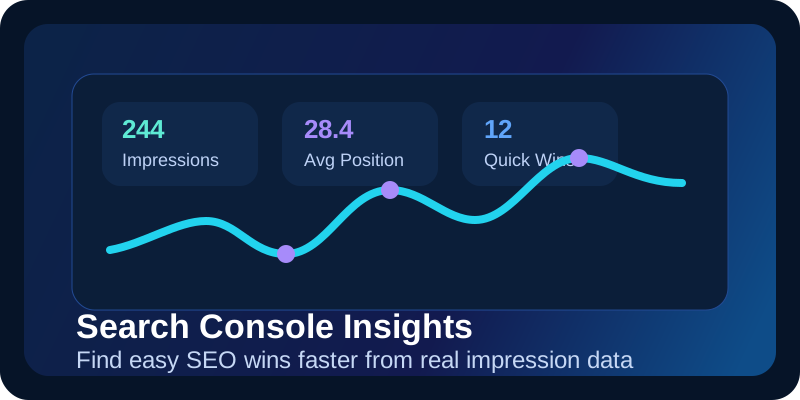
Inspect important pages manually, submit the sitemap, and review priority landing pages in Search Console and analytics platforms.
Where this fits in the bigger growth system
Technical SEO protects the whole content cluster. It supports pillar SEO strategy, conversion-focused pages, and AI visibility readiness.
The commercial risk of weak launch governance
A poor launch affects more than rankings. It can weaken paid campaign performance, break attribution, reduce enquiry flow, and damage trust if high-intent landing pages load slowly or return errors.
That is why launch QA should be treated as revenue protection, not only as a technical clean-up task for developers.
Why launch-day SEO should be treated like risk management
Technical SEO at launch is really a risk-control exercise. The goal is to protect visibility, attribution, page experience, and revenue-critical landing pages before avoidable errors can affect rankings or lead flow.
That is why launch preparation should sit close to build QA, technical SEO, and delivery planning rather than being treated as an afterthought once the site is already live.
Questions to ask before the launch is signed off
- Have redirects, canonicals, sitemaps, and analytics all been tested manually?
- Do the highest-value landing pages load fast and show the correct metadata?
- Is there a post-launch review plan for Search Console, crawl errors, and conversion tracking?
Who this is for
- UK businesses comparing suppliers for technical seo checklist uk and looking for a commercially credible next step.
- Internal teams that need clearer expectations around budget, delivery scope, workflow quality, or search performance.
- Decision-makers reviewing seo options and trying to reduce risk before committing to a project or retainer.
Common mistakes to avoid
A common mistake is treating technical seo checklist uk like a checklist exercise instead of a commercial decision. That usually leads to vague scope, weak implementation detail, and pages that look acceptable but do not create enough trust or conversion momentum.
Another mistake is focusing only on surface-level SEO phrases without connecting the page to proof, FAQs, pricing logic, service scope, and internal links. Search engines increasingly reward stronger context, while real buyers still expect clarity before they enquire.
What this means in practice
If a business is actively researching technical seo checklist uk, they usually want clear next steps rather than broad theory. The strongest pages help the reader compare options, understand likely timelines, and see what affects scope, cost, or implementation quality.
This is also why long-form content tends to perform better when it stays commercially focused. Search visibility improves when the article answers related questions thoroughly, but conversions improve when the page also explains proof, process, and realistic outcomes in plain language.
For UK service brands, the best-performing pages also reduce commercial ambiguity. They show what happens first, what gets quoted, what affects timelines, and where the engagement fits alongside pricing, implementation, and support.
Implementation checklist
- Define the exact commercial goal behind technical seo checklist uk before expanding delivery scope.
- Align the page with related service, pricing, case-study, and FAQ content so Google and buyers can follow the topic clearly.
- Use Search Console data, internal linking, and conversion tracking to measure whether the page is attracting useful visibility instead of low-value impressions.
- Review the content regularly so it stays relevant, trustworthy, and commercially stronger than generic competitor pages.
- Run a pre-launch crawl, redirect test, metadata review, and Search Console handover checklist before the site is exposed to live traffic.
Frequently Asked Questions
Should Search Console be configured before or after launch?
Before is better where possible, but the sitemap submission and inspection workflow must happen immediately after launch.
What technical issue causes the most damage on launch?
Indexing and redirect mistakes are usually the most damaging because they can break rankings across many URLs at once.
Further Reading
Continue with Search Console monitoring, AI visibility planning, and our technical SEO support.
Next Step
Use this with our SEO service, launch-ready web builds, and technical launch planning support.
If a launch is approaching, the safest next step is a final technical QA pass covering redirects, metadata, crawlability, analytics, and post-launch checks. Small misses here can create outsized ranking losses.
Next Step Resources
Move from research into action with the most relevant service, proof, pricing, and project planning pages for this topic.

Tags:








































Leave a Comment
Ask a practical question, share a project insight, or add a useful note. Every comment is reviewed before it appears publicly.