
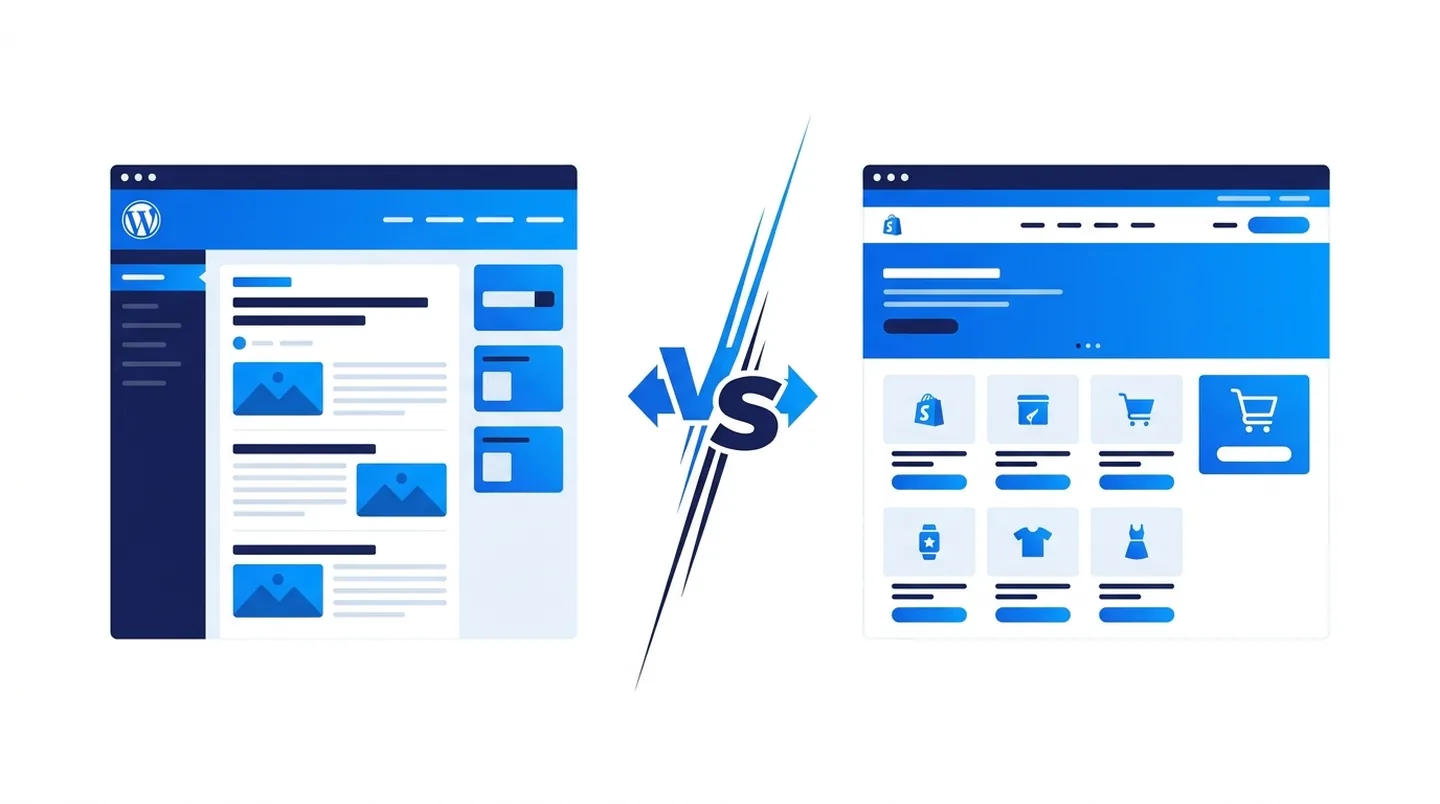
Blog post overview and metadata
Author, publish date, read time, and category
WordPress vs Shopify for UK Small Business: Which Should You Choose?
Reviewed by: ARS Developer Team | Updated: 30 Sep 2026 | UK Focus: Buyer-intent SEO, web delivery, and measurable conversion growth.
Quick Summary
WordPress or Shopify for your UK small business? A practical comparison of cost, SEO, ecommerce, maintenance and control to help you choose with confidence.
In This Guide
Why This Article Is Trustworthy
- Reviewed by the ARS Developer editorial team for UK business relevance.
- Structured around buyer-intent SEO, technical delivery, and measurable conversion outcomes.
- Connected to related service pages, pricing guidance, and supporting articles for stronger topic depth.
For a UK small business, the platform you choose shapes your costs, your SEO and how easily you can grow. WordPress and Shopify are both excellent — for different jobs. Here is a practical comparison to help you choose.
Quick Answer
Choose Shopify if selling products online is your main goal. Choose WordPress if content, services, blogging and full design control matter more than a built-in checkout. Many businesses use WordPress for the brand site and a separate Shopify store for products.
Cost
Shopify has a predictable monthly fee plus app costs and transaction fees. WordPress is open-source (free software) but you pay for hosting, a theme and plugins — and a developer if you want something custom. For a simple shop, Shopify is often cheaper to run; for content-heavy sites, WordPress can be more economical.
Ecommerce
Shopify is purpose-built for selling: checkout, payments, inventory, shipping and apps all work out of the box. WordPress needs WooCommerce and more setup, but offers more flexibility for unusual requirements.
SEO & Content
Both can rank well. WordPress has the edge for large content operations and fine-grained control. Shopify is strong for product SEO and is improving constantly. Technical SEO and Core Web Vitals matter more than the platform itself.
Maintenance & Control
Shopify handles hosting, security and updates for you — less maintenance, less control. WordPress gives you full control and ownership but you are responsible for updates, security and backups.
Which Should a UK Small Business Choose?
- Product-first store → Shopify.
- Service business, blog, full design control → WordPress.
- Complex custom workflow → consider a custom build (Laravel) instead of either.
The numbers that actually differ
Shopify charges a monthly fee and, if you use a payment provider other than Shopify Payments, an additional transaction percentage on top of the card fee. WooCommerce has no platform fee but moves those costs to hosting, plugin licences and the person who keeps it updated. For a low-volume store the second is usually cheaper; the crossover comes sooner than most merchants expect.
Work out your own number before choosing: monthly orders multiplied by average value, against the fee structures. A decision made on the sticker price alone is frequently reversed within two years.
Checkout control and content depth pull in opposite directions
Shopify's checkout is the strongest part of the platform and the part you can least modify. That is a good trade for most retailers and a bad one for anyone whose sale needs a step the checkout does not have, such as a quote, an approval, or a configuration.
WordPress wins where content does the selling — a business whose traffic comes from long articles, guides and local pages usually finds WordPress less of a fight. Deciding which of the two describes your business is more useful than comparing feature lists.
Frequently Asked Questions
Is Shopify or WordPress better for SEO?
Both can rank well. WordPress offers more content control; Shopify is strong for product pages. Execution matters more than the platform.
Can I move from Shopify to WordPress later?
Yes, content and products can be migrated, though it takes planning. Choosing well first saves a migration.
Next Step Resources
Move from research into action with the most relevant service, proof, pricing, and project planning pages for this topic.

Tags:
































































Leave a Comment
Ask a practical question, share a project insight, or add a useful note. Every comment is reviewed before it appears publicly.