

Blog post overview and metadata
Author, publish date, read time, and category
How UK Businesses Get Recommended by AI Search (ChatGPT, Gemini & Copilot) in 2026
Reviewed by: ARS Developer | Updated: 31 Jul 2026 | UK Focus: Buyer-intent SEO, web delivery, and measurable conversion growth.
Quick Summary
AI assistants now answer buyer questions before Google gets a look-in. This plain-English UK guide explains how ChatGPT, Gemini and Copilot decide which companies to name, and gives you a 12-check AI Visibility Audit to run this week to earn more recommendations.
In This Guide
- Why AI search optimisation UK matters now
- How do AI assistants decide which companies to recommend?
- What is generative engine optimisation UK, and how does it differ from SEO?
- Why UK local businesses have a real advantage
- The AI Visibility Audit: 12 checks to run this week
- What does AI search optimisation cost in the UK?
- How do I get my business recommended by ChatGPT specifically?
- The honest limits of AI search optimisation
Why This Article Is Trustworthy
- Reviewed by the ARS Developer editorial team for UK business relevance.
- Structured around buyer-intent SEO, technical delivery, and measurable conversion outcomes.
- Connected to related service pages, pricing guidance, and supporting articles for stronger topic depth.
AI search optimisation UK is the practice of making your business easy for AI assistants like ChatGPT, Gemini and Microsoft Copilot to understand, trust and recommend by name. In 2026 it typically costs a UK SME between £1,500 and £6,000 to get the foundations right, and the businesses winning are the ones with a strong, consistent digital identity, not the biggest ad budgets.
At ARS Developer, a software development company in Stoke-on-Trent, we've watched buyer behaviour shift fast. A prospect used to type "accountant near me" into Google and scan ten blue links. Now they ask ChatGPT "who's a good accountant for a limited company in the Midlands?" and get three named recommendations with reasons. If your business isn't one of the three, you never entered the conversation. This guide explains, in plain English, how AI assistants choose who to recommend, and gives you a practical framework to earn those recommendations.
Why AI search optimisation UK matters now
AI assistants have quietly become a first-stop research tool for millions of UK buyers. Instead of returning a list of links, they return an answer, and often a shortlist of specific companies. This changes the game. On Google page one there are ten organic slots. In an AI answer there are frequently just three named businesses, sometimes one. Visibility has become winner-takes-most.
Across 50+ UK projects we've delivered, the pattern we see most is that owners assume this is a far-future problem. It isn't. We're already seeing enquiry forms where the prospect says "ChatGPT suggested you." The businesses treating AI SEO 2026 as a live channel, not a science-fiction concern, are compounding an advantage that later entrants will struggle to close.
The good news for UK SMEs: you don't need a huge brand to win. AI assistants reward clarity and consistency, which a focused local business can achieve far more easily than a sprawling national one.
How do AI assistants decide which companies to recommend?
AI assistants recommend companies they can confidently identify and verify. They pull from their training data, live web results and connected sources, then favour businesses with a clear identity, consistent information across the web, credible reviews and quotable, well-structured content. In short: they recommend what they can trust and easily summarise.
Under the bonnet, several signals do the heavy lifting. You don't need to master the technology, but you do need to know what feeds it.
Entity strength (does the AI know who you are?)
An "entity" is simply a thing the AI recognises as real and distinct, your company as a defined organisation rather than a vague web address. Entity strength grows when your business name, services, location and founder are described the same way everywhere the AI looks. Weak, inconsistent identity means the AI can't be sure you're a real, credible option, so it stays quiet.
Structured data (machine-readable facts)
Structured data, or schema markup, is hidden code on your website that spells out facts in a format machines read instantly: "This is a business. Name: X. Location: Stoke-on-Trent. Services: Y. Rating: 4.9." It removes guesswork. Our own technical SEO service treats schema as a foundation, not an afterthought, precisely because AI systems lean on it heavily.
Consistent citations (the same facts, everywhere)
A citation is any mention of your business details across the web, your Google Business Profile, Companies House, directories, industry bodies, press. When your name, address and phone number match perfectly across all of them, trust rises. When they conflict, the AI hedges and picks a competitor it's surer about.
Review signals
Volume, recency and consistency of reviews act as social proof the AI can quantify. A steady stream of recent, detailed Google reviews signals a live, credible business far more strongly than a handful of five-year-old ratings.
Quotable content
AI assistants love content they can lift and paraphrase: clear definitions, direct answers, honest comparisons, specific numbers. Vague marketing waffle gives them nothing to quote. Content that answers real questions plainly gets pulled into answers.
What is generative engine optimisation UK, and how does it differ from SEO?
Generative engine optimisation UK (GEO) is the practice of optimising your content and digital presence so generative AI engines cite and recommend you in their answers. Traditional SEO aims to rank a page in a list of links; GEO aims to make your business the answer, or part of it, when an AI responds to a question.
The overlap is large and reassuring. Much of what makes you rank on Google, authoritative content, clean technical foundations, strong reviews, also makes AI assistants trust you. But GEO adds emphasis on being quotable, being consistently described as a clear entity, and appearing in the third-party sources AI systems trust. Think of GEO and AEO for business (answer engine optimisation) as SEO's close cousins, sharing the same DNA but optimised for a world where the answer arrives pre-written.
Why UK local businesses have a real advantage
National brands often have the opposite problem to SMEs: their information is scattered across hundreds of pages, franchises and legacy profiles, creating exactly the inconsistency AI assistants distrust. A focused UK service business can present one clean, coherent identity.
Local specificity also plays to your favour. When someone asks "who does commercial electrical work in Staffordshire?" the AI needs businesses tied clearly to that place and service. A well-optimised local firm with matching citations, local reviews and location schema is exactly what the assistant is looking for. Our local SEO guide for Staffordshire businesses covers the citation and Google Business Profile groundwork that doubles as AI-recommendation fuel.
Across the UK service firms we work with, the pattern is consistent: tight geographic focus plus consistent data beats broad reach plus messy data almost every time in AI answers.
The AI Visibility Audit: 12 checks to run this week
This is our named framework, the AI Visibility Audit, a dozen practical checks you can complete in an afternoon to see how ready your business is to be recommended by AI. Score each one yes or no; every "no" is a specific job to fix.
- Ask the assistants directly. Type "best [your service] in [your town]" into ChatGPT, Gemini and Copilot. Are you named? This is your baseline.
- Check your name consistency. Is your exact business name identical on your website, Google Business Profile, Companies House and top directories?
- Verify NAP match. Name, address and phone number, identical everywhere, no old addresses lingering on directories.
- Confirm Organisation schema exists. Does your homepage carry structured data naming your business, location and services? (A developer can confirm in minutes.)
- Confirm LocalBusiness and review schema. Are your location and star ratings marked up so machines read them?
- Audit your Google reviews. Do you have recent reviews (within 90 days) and are you replying to them?
- Check third-party mentions. Are you cited on relevant UK directories, industry bodies or local press?
- Test your quotability. Does your site have clear, direct answers to the questions buyers actually ask, in plain sentences?
- Review your About page. Does it clearly state who you are, where you are, who founded you and what you do, the raw facts an AI needs?
- Check page speed and crawlability. Can bots reach and read your key pages quickly, without being blocked?
- Look for contradictions. Do any old pages, PDFs or profiles state conflicting services, prices or locations?
- Set up AI referral tracking. Can you see visits arriving from chatgpt.com, gemini.google.com or copilot in your analytics?
Score 10 or more and you're in strong shape. Score below seven and you have clear, high-value work ahead, most of it foundational and one-off rather than ongoing.
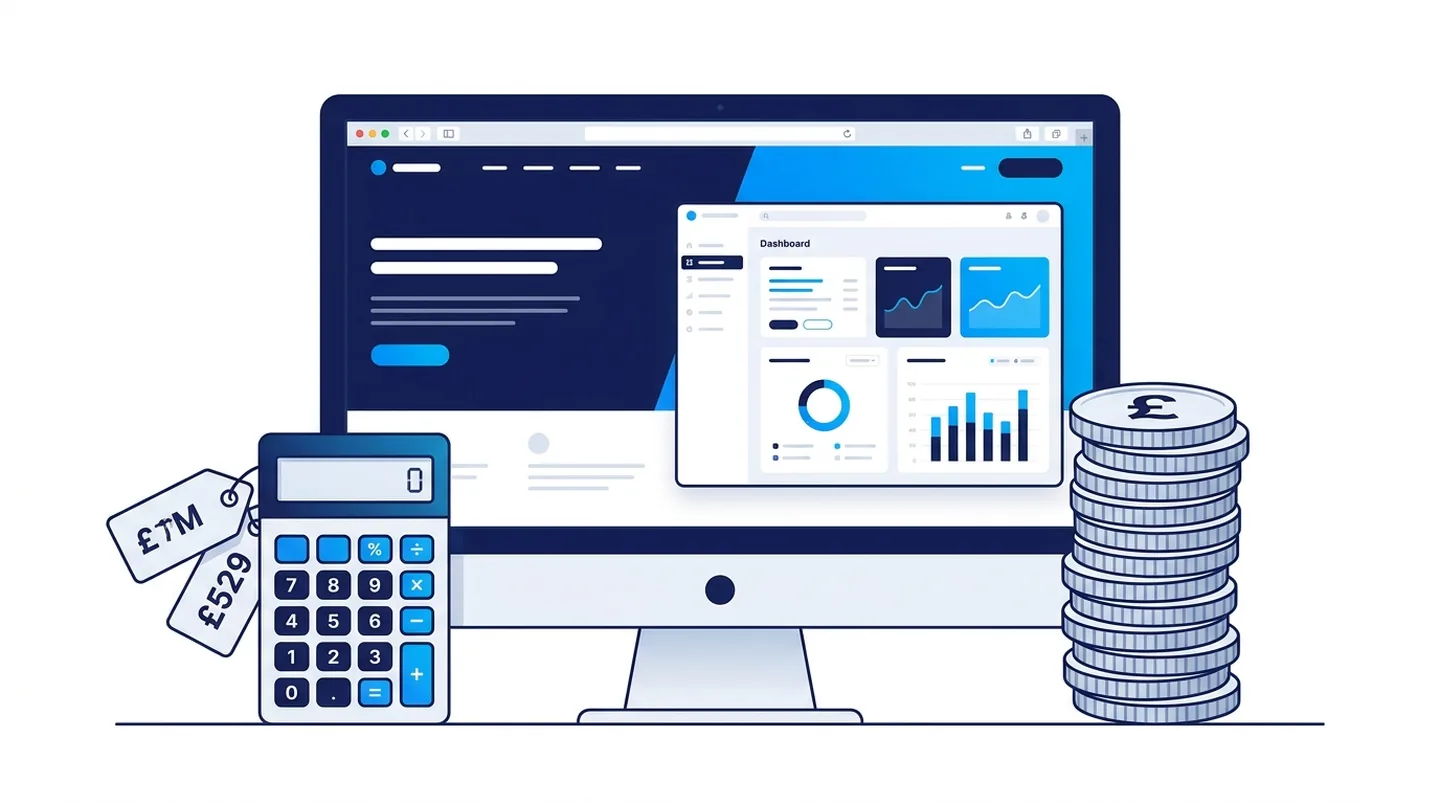
What does AI search optimisation cost in the UK?
Costs vary with the state of your current foundations, but the work is more affordable than most owners expect because much of it is one-off setup rather than a permanent retainer. Here's a realistic 2026 breakdown in GBP.
| Work package | What it covers | Typical UK cost (2026) | Type |
|---|---|---|---|
| AI Visibility Audit | Full review against the 12 checks, prioritised action list | £400 – £900 | One-off |
| Schema & technical foundations | Organisation, LocalBusiness, review and FAQ structured data | £600 – £2,000 | One-off |
| Citation & entity clean-up | Consistent NAP across directories, Google Business Profile fixes | £500 – £1,500 | One-off |
| Quotable content build | Answer-first pages, definitions, FAQs targeting buyer questions | £800 – £3,000 | Project |
| Review generation system | Automated review requests after each job or sale | £400 – £1,200 | Setup + light retainer |
| Ongoing content & monitoring | Fresh answer content, tracking AI mentions monthly | £300 – £900/month | Optional retainer |
Most UK SMEs get a solid foundation for £1,500 to £6,000 in one-off work, then decide whether ongoing content is worth a modest monthly spend. Beware anyone promising guaranteed AI rankings for a fixed fee, no one can guarantee what a model outputs, and we'll come to that honestly below.
How do I get my business recommended by ChatGPT specifically?
Getting recommended by ChatGPT comes down to being the clearest, most-verified answer to a buyer's question. There's no submission form and no advert to buy. You earn it by strengthening the signals above and giving the model unambiguous facts to work with.
In practice, the highest-leverage moves are: publish answer-first content that directly addresses the questions your buyers ask; make sure your business is described identically everywhere; add structured data so your facts are machine-readable; and build a steady flow of recent reviews. Do those four things well and you become the low-risk choice the assistant reaches for. Our UK Growth Hub collects the wider playbook for turning these foundations into enquiries.
The honest limits of AI search optimisation
We'd be doing you a disservice to pretend this channel is precise or instant. Two honest caveats matter.
Measurement is genuinely hard. Unlike Google, AI assistants don't hand you a tidy dashboard of impressions and clicks. You can track referral visits from AI domains and periodically ask the assistants how they describe you, but attribution is fuzzy. Many AI-influenced enquiries arrive as "direct" traffic or a phone call, invisible in analytics.
It compounds slowly. Entity strength and citation consistency build over weeks and months, not days. Models also update on their own schedules, so a change you make today may not surface in answers for some time. Expect a 3 to 6 month horizon before the picture shifts meaningfully. Anyone promising overnight results is selling hype, not generative engine optimisation UK.
The upside of that slowness is durability. Because these foundations compound and are hard to fake, once you're the trusted answer, you tend to stay it.
A simple order of operations
If the twelve checks feel like a lot, sequence them. Fix the foundations first, because everything else builds on them.
- Weeks 1–2: Run the AI Visibility Audit and clean up name, address and citation consistency.
- Weeks 3–4: Add structured data and tighten your About and core service pages into clear, factual, quotable content.
- Weeks 5–8: Build answer-first content around real buyer questions and switch on a review-generation habit.
- Ongoing: Track AI referrals, re-test the assistants monthly, and keep publishing plain answers to new questions.
Frequently asked questions
How do I get my business recommended by ChatGPT?
You can't pay or submit to be recommended. You earn it by becoming the clearest, most-verified answer: consistent business details everywhere, structured data on your site, recent Google reviews, and plain, answer-first content addressing your buyers' questions. Do these well and ChatGPT reaches for you as the low-risk recommendation.
What is generative engine optimisation?
Generative engine optimisation (GEO) is optimising your content and online presence so AI engines like ChatGPT, Gemini and Copilot cite and recommend you in their answers. Where traditional SEO aims to rank a link, GEO aims to make your business part of the answer itself, prioritising clarity, quotability and consistent, verifiable facts.
Is AI search replacing Google in the UK?
Not replacing, but reshaping. Google remains the largest UK search channel and is itself adding AI answers. A growing share of buyers now research through AI assistants first, so the smart approach is optimising for both. The good news: strong foundations, content, reviews, technical health, serve traditional search and AI equally well.
Do Google reviews affect AI recommendations?
Yes, significantly. Reviews are quantifiable social proof that AI systems can read and weigh. Volume, recency and consistency all matter, a steady flow of recent, detailed reviews signals a live, trustworthy business. Marked up with review schema, your ratings become machine-readable facts that strengthen your case for being recommended.
Does schema markup matter for AI search?
Very much. Schema markup is hidden code that states your facts, name, location, services, ratings, in a format machines read instantly, removing guesswork. AI systems favour businesses they can identify confidently, and clean Organisation, LocalBusiness and review schema make that identification straightforward. It's one of the highest-value one-off jobs you can do.
How do I track traffic from AI assistants?
Check your analytics for referrals from domains like chatgpt.com, gemini.google.com and copilot.microsoft.com, and set up a segment for them. Also periodically ask each assistant how it describes your business. Attribution stays imperfect, many AI-influenced enquiries arrive as direct traffic or phone calls, so treat trends, not exact numbers, as your guide.
Getting started
AI search optimisation UK isn't a gimmick, it's the natural next step for businesses that already value a clear identity, honest content and happy customers. The firms that act in 2026 will bank a compounding advantage that late movers find expensive to catch.
If you'd like to know exactly where you stand, ARS Developer, a software development company in Stoke-on-Trent, offers a free growth audit that runs your business through the AI Visibility Audit and returns a prioritised, plain-English action list. Book a free 30-minute discovery call with the founder and we'll respond within one business day, no account managers, no jargon, just a clear view of how to get recommended.
Next Step Resources
Move from research into action with the most relevant service, proof, pricing, and project planning pages for this topic.

Tags:







































Leave a Comment
Ask a practical question, share a project insight, or add a useful note. Every comment is reviewed before it appears publicly.