

Blog post overview and metadata
Author, publish date, read time, and category
Subscription Fatigue: When Replacing 6 SaaS Tools With One Laravel System Pays Off
Reviewed by: ARS Developer | Updated: 31 Jul 2026 | UK Focus: Buyer-intent SEO, web delivery, and measurable conversion growth.
Quick Summary
Six SaaS subscriptions quietly become a five-figure annual bill. We break down a typical UK SME software stack, the three-year cost, and the exact break-even maths that tells you when replacing SaaS with custom software actually pays off, and when it does not.
In This Guide
- What is SaaS sprawl, and why does it cost more than the invoices show?
- How much do UK businesses spend on SaaS? A typical stack audited
- Is custom software cheaper than SaaS subscriptions?
- The break-even maths: build vs subscribe
- The Consolidation Threshold: our framework for deciding
- The real risks of replacing SaaS with custom software, handled honestly
- When SaaS remains the right answer
- A pre-decision checklist before you commit
Why This Article Is Trustworthy
- Reviewed by the ARS Developer editorial team for UK business relevance.
- Structured around buyer-intent SEO, technical delivery, and measurable conversion outcomes.
- Connected to related service pages, pricing guidance, and supporting articles for stronger topic depth.
To replace SaaS with custom software profitably, your combined subscription bill usually needs to exceed roughly £1,500–£2,500 per month before a consolidated build breaks even inside three years. Below that, off-the-shelf SaaS is normally the cheaper, safer choice. Above it, a custom Laravel system often pays for itself in 18–30 months.
Most UK service businesses do not decide to build a sprawling software stack. It accumulates. A CRM here, a scheduling tool there, a separate invoicing app, cloud storage, a forms tool, a reporting dashboard, each added to solve one urgent problem. Two years later you are paying for six or seven subscriptions, re-typing the same customer details across three of them, and wondering where the money went. At ARS Developer, a software development company in Stoke-on-Trent, this is one of the most common conversations we have with ops directors and business owners: at what point does it make financial sense to replace SaaS with custom software and consolidate the lot into one system you own?
This article gives you the real maths. We will audit a typical UK SME stack, project the three-year cost, walk through the break-even calculation for a consolidated custom build, share the named framework we use to decide, and be honest about when SaaS should stay exactly where it is.
What is SaaS sprawl, and why does it cost more than the invoices show?
SaaS sprawl is the gradual accumulation of overlapping subscription software tools across a business, each solving a narrow problem while quietly duplicating data, licences and admin effort across the others. The monthly invoices are only the visible cost.
The hidden costs are where SaaS sprawl really bites. When your CRM, scheduling tool and invoicing app do not talk to each other, someone re-enters the same customer twice or three times. That is minutes per record, hours per week, and a steady stream of transcription errors, wrong addresses, mismatched quotes, double bookings. Add per-user pricing that scales every time you hire, annual price rises of 8–15% that have become normal since 2023, and the "small" £29-a-month tools that nobody remembers signing up for, and the true cost of your stack is typically 30–50% higher than the headline subscription total once staff time is included.
Across 50+ UK projects we have delivered, the pattern we see most is that businesses underestimate their real SaaS spend by around a third, because the cost is spread across different cards, departments and renewal dates. Nobody is looking at the total in one place. That is the first thing worth fixing, whether or not you ever build anything.
How much do UK businesses spend on SaaS? A typical stack audited
Let us make this concrete. Below is a realistic software stack for a UK service business, say a 12-person trades firm, clinic group, or B2B agency, with monthly and three-year totals in GBP. The exact figures vary by vendor and headcount, but the shape of it will feel familiar.
| Tool category | What it does | Typical monthly cost (12 users) | 3-year cost (incl. ~10%/yr rises) |
|---|---|---|---|
| CRM | Stores contacts, deals and sales pipeline | £360 | £14,300 |
| Online forms & lead capture | Website enquiry and intake forms | £45 | £1,790 |
| Scheduling / bookings | Appointments, job calendars, reminders | £180 | £7,150 |
| Invoicing & quotes | Estimates, invoices, payment links | £150 | £5,960 |
| File storage & sharing | Documents, photos, contracts | £120 | £4,770 |
| Reporting / dashboards | KPIs pulled from the tools above | £95 | £3,770 |
| Total | Six tools, none fully integrated | £950/mo | £37,740 |
That is roughly £11,400 in year one, climbing to nearly £38,000 over three years for six tools alone, before you count the staff hours spent moving data between them. Larger teams, or stacks that include marketing automation, help desk, e-signature and project management, routinely pass £2,500–£4,000 per month. This is what people mean by SaaS subscription costs business owners more than they realise: the number compounds, and per-seat pricing means it grows fastest exactly when you are growing.
If you want a broader view of the buy-versus-build decision beyond consolidation specifically, our custom software vs off-the-shelf cost reality check breaks down the full comparison with UK pricing.
Is custom software cheaper than SaaS subscriptions?
Not immediately, and anyone who tells you otherwise is selling something. Custom software has a large upfront cost and near-zero per-user cost thereafter; SaaS has a low upfront cost and a per-user cost that never stops. Which is cheaper depends entirely on how long you run it and how many people use it.
A consolidated custom Laravel application UK businesses typically commission to replace a six-tool stack costs in the region of £18,000–£45,000 to build, depending on complexity, plus modest ongoing hosting and maintenance of roughly £150–£500 per month. Laravel is a mature, open-source PHP framework we use because it is fast to build on, well supported, and does not lock you into any vendor. The key difference: once it is built, adding your thirteenth or fiftieth user costs you nothing extra. That is the mechanic that makes consolidation pay off as you scale.
The break-even maths: build vs subscribe
Here is the calculation we walk clients through. It is deliberately simple, because the decision should not need a spreadsheet only a consultant can read.
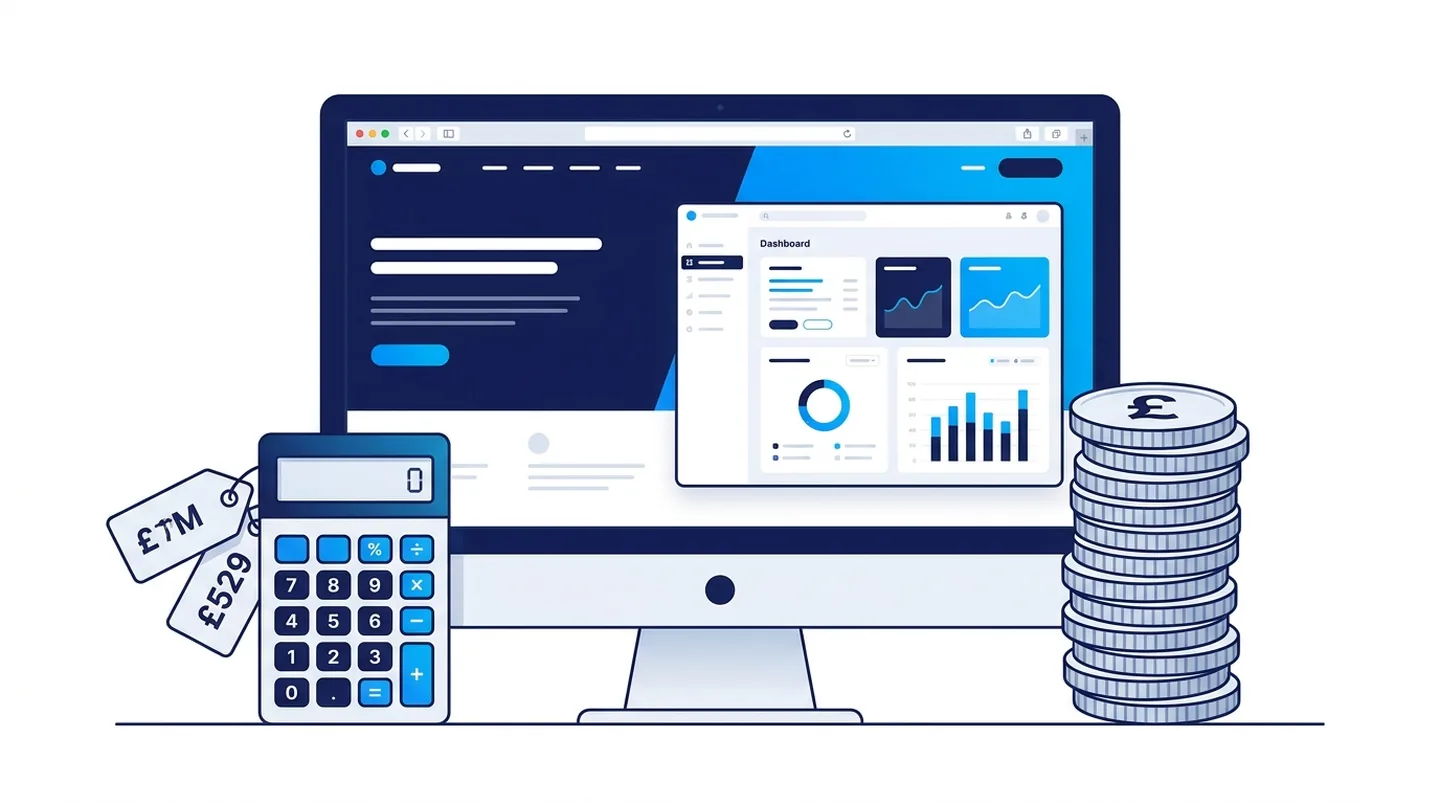
Break-even point (months) = Build cost ÷ (Current monthly SaaS spend − New monthly running cost)
Take the audited stack above. Say a consolidated custom build costs £30,000, current SaaS spend is £950/month, and the new system costs £300/month to host and maintain. Your monthly saving is £650. Break-even is £30,000 ÷ £650 = roughly 46 months, just under four years. On those numbers alone, building is a marginal call.
Now run it for a growing 25-person business paying £2,200/month across the same tool categories. Same £30,000 build, £300/month running cost, monthly saving of £1,900, break-even in under 16 months. Everything after that is money back in the business, plus you own the asset. This is why the decision hinges on the size of your bill, not on any general belief that "custom is better" or "SaaS is cheaper".
One caveat we always add: include the staff-time saving from removing double data entry. If consolidation saves each of ten staff even 20 minutes a day, that is real recovered capacity worth thousands per year, and it usually shortens break-even by several months. We treat that as a bonus rather than the headline, because it is harder to bank than a cancelled subscription.
The Consolidation Threshold: our framework for deciding
Over dozens of these assessments we developed a simple named framework, The Consolidation Threshold, to cut through the emotion of "we're paying too much for software" and reach a defensible decision. You cross the threshold, and consolidation becomes worth costing seriously, when you can answer yes to most of the following.
- Spend test: Your combined stack exceeds roughly £1,500/month, or £18,000/year.
- Duplication test: The same data (customers, jobs, invoices) is entered into two or more tools by hand.
- Growth test: Per-seat pricing means your bill rises every time you hire, with no ceiling in sight.
- Fit test: You are paying for features you never use, while working around gaps the tools cannot close.
- Process test: Your workflow is genuinely specific to how you operate, not a generic sales or booking flow.
- Horizon test: You expect to be running this business, in roughly this shape, for at least three more years.
Score four or more, and the break-even maths is likely to favour a build; it is worth getting a proper quote. Score two or fewer, and you almost certainly should not consolidate business software into a custom system yet, tighten up your SaaS instead (more on that below). The framework is not a licence to build; it is a filter that stops you building for the wrong reasons.
The real risks of replacing SaaS with custom software, handled honestly
We would rather talk you out of a bad build than sell you a regret. These are the genuine risks, and how a competent partner mitigates each.
- Upfront cost and cash flow. £18k–£45k is real money. Mitigation: phased delivery with clear milestones, and, in our case, no payment until each stage is approved, so you are never funding work you have not seen.
- You now own maintenance. SaaS vendors patch and update for you; with custom software that becomes your responsibility. Mitigation: a fixed, modest monthly support arrangement, and building on a well-supported framework rather than something obscure.
- Build risk. Custom projects can overrun or under-deliver. Mitigation: tight scope, weekly progress you can see, and a founder-led team rather than being passed to a junior after the sales call.
- Feature gaps. Mature SaaS has had years of polish you cannot replicate on day one. Mitigation: consolidate your core workflow first, keep best-in-class SaaS for genuinely specialised jobs, and integrate rather than rebuild.
- Performance under load. A custom system is only an asset if it is fast. Poorly built ones crawl as data grows; our guide to Laravel performance bottlenecks costing orders covers the specific issues we design out from the start.
Across the projects we have delivered, the failures we have seen elsewhere almost always trace back to two things: scope that ballooned because nobody drew a line, and a business that built at the wrong time, before it had a stable, repeatable process worth encoding. Both are avoidable with honest scoping up front.
When SaaS remains the right answer
Plenty of the time, keeping your subscriptions is the smart move, and we will say so. SaaS wins when your total spend is modest (under about £1,000/month), when your processes are genuinely standard and well served by off-the-shelf tools, when you are still figuring out how the business runs, or when a specialist tool does something so well that rebuilding it would be wasteful. Accounting software, payroll, and email are classic examples we rarely recommend replacing.
The build-vs-subscribe question is not a moral one. It is a cost curve. Below the threshold, SaaS is cheaper, faster to adopt and lower risk. Above it, ownership starts to win. A good approach is often hybrid: a custom core that holds your customers, jobs and money in one place, integrated with the two or three specialist SaaS tools genuinely worth keeping. You do not have to replace everything to escape SaaS sprawl, you have to replace the overlapping, duplicated middle.
A pre-decision checklist before you commit
Before you spend a penny on a build, or renew another annual contract, work through this.
- List every SaaS subscription with its monthly cost, renewal date and number of active users.
- Add up the annual total, then add 30% to estimate the true cost including staff data-entry time.
- Mark which tools share the same data (your consolidation candidates) and which are genuinely specialist (keepers).
- Run the break-even formula with a realistic build quote, not a guess.
- Score yourself against the six Consolidation Threshold tests above.
- Check which specialist tools offer an API, so a custom core can integrate rather than replace them.
- Decide your three-year horizon honestly, if the business shape is uncertain, wait.
If you would like help doing this properly, our custom software development service starts with exactly this audit, and you can see indicative build costs on our pricing page before any conversation.
Frequently asked questions
Is custom software cheaper than SaaS subscriptions?
Over a long enough period and with enough users, yes. Custom software costs more upfront (typically £18,000–£45,000 for a consolidated build) but almost nothing per extra user, while SaaS charges per seat forever. If your stack exceeds roughly £1,500–£2,500 per month, a custom system usually breaks even within 18–30 months.
How much do UK businesses spend on SaaS?
A typical 12-person UK service business runs a six-tool stack costing around £900–£1,200 per month, or £11,000–£15,000 in year one, rising with per-seat growth and annual price increases of 8–15%. Larger or more complex teams frequently pass £2,500–£4,000 per month once every tool is counted.
What are the risks of replacing SaaS with custom software?
The main risks are upfront cost, taking on maintenance yourself, project overrun, and missing polished SaaS features on day one. Each is manageable with tight scope, milestone-based payment, a well-supported framework like Laravel, and a hybrid approach that keeps genuinely specialist tools rather than rebuilding everything at once.
How long until a custom system pays for itself?
Divide the build cost by your monthly saving (current SaaS spend minus new running cost). For a £30,000 build saving £1,900 a month, that is under 16 months; saving only £650 a month, it is nearly four years. The bigger your current bill, the faster it pays back.
Can custom software integrate with the tools I want to keep?
Yes. A well-built custom system does not have to replace everything. Most quality SaaS tools offer an API, a standard way for software to exchange data, so your custom core can pull invoices, bookings or accounting data automatically from specialist tools you keep, ending double entry without a full rebuild.
What is SaaS sprawl?
SaaS sprawl is the unplanned build-up of many overlapping subscription tools across a business, each bought to solve one problem while duplicating data and admin across the others. It inflates costs by 30–50% beyond the visible invoices once staff time and duplicated licences are counted.
The bottom line
Replacing SaaS with custom software is a numbers decision, not a fashion one. Below roughly £1,500 a month, keep subscribing. Above it, especially where you are re-typing the same data across tools and paying more with every hire, a consolidated build starts to pay for itself, and you end up owning the asset instead of renting it forever. Run the break-even formula, apply the Consolidation Threshold, and be honest about your horizon.
If your monthly software bill has crept past the point of comfort, ARS Developer, a software development company in Stoke-on-Trent, offers a free growth audit of your stack: we will total your true spend, run the break-even maths, and tell you plainly whether to build or stay put. Book a free 30-minute discovery call with the founder and we will respond within one business day, no obligation, and no sales pressure to build something you do not need.
Next Step Resources
Move from research into action with the most relevant service, proof, pricing, and project planning pages for this topic.

Tags:



































Leave a Comment
Ask a practical question, share a project insight, or add a useful note. Every comment is reviewed before it appears publicly.